Creating a Safe Place for Veterans Dealing with Military Trauma
by Roy Savage, HTOP Coordinator
For many veterans, the battles do not end when their service concludes. Military trauma—whether from combat, training, or the burdens of military life—can follow them home, manifesting as invisible wounds that shape their relationships, careers, and daily lives. These experiences can leave veterans feeling isolated, misunderstood, and reluctant to share their struggles. That is why creating a safe place for them begins with one simple but powerful act: listening to understand.
Listening to understand is different from listening to reply. It means entering a conversation without judgment, without rushing to provide solutions, and without minimizing what the veteran has endured. Too often, well-meaning friends or family members try to “fix” the problem quickly, when in truth, what most veterans need is to be seen, heard, and validated. By offering patient, compassionate listening, we build trust and give veterans permission to speak openly about what they carry.
A safe space is not defined by walls, but by presence. When veterans know they can speak without fear of being dismissed or stigmatized, they are more likely to take the courageous step of sharing their stories. That safe space can be a living room, a coffee shop, or a community group—it exists wherever empathy and respect are practiced. Creating it requires humility: acknowledging that we may not fully grasp their experiences, but we are willing to learn and to simply stand with them in their journey.
Ultimately, listening to understand is an act of service in itself. It honors the sacrifices veterans have made and helps restore their sense of belonging. In a world where many feel alone with their pain, offering a safe place through genuine listening can be the first step toward healing, connection, and hope.
Moving Mindfully Through Pain
by Mari Hodges, MScMed (Pain Mgmt), TPS, M.AmSAT, AAPTA
Therapeutic Pain Specialist & Certified Alexander Technique Teacher
We know that movement and physical activity are good for us, and for almost anyone experiencing persistent pain, movement is positive. But if moving hurts, it’s hard to get very motivated to move. When movement is accompanied by pain, why would you want to?
Moving mindfully can help us to live more easily with persistent pain and bring back more control over life when it’s been taken away by pain. Mindful movement means being present in your body and your surrounding space in the moment as you move. Mindful movement is a dialog with your body. It means not shying away from movement and not doing too much.
So how do you do it if you have persistent pain?
First, I believe it’s helpful to think about why you would, because our beliefs play an important role in how we feel and what we do about how we feel. A key thing to know is that pain and injury (or tissue damage) are not the same thing. Pain in its normal role keeps us from doing too much, but in many chronic pain conditions, that function goes awry. Persistent pain typically involves hypersensitivity of the nervous system such that things that won’t damage us hurt. Knowing that pain doesn’t necessarily mean damage can help us to re-engage with physical activity.
The next thing to know is that movement can actually help reduce pain, while continually reducing movement will likely make it worse over time. Physical activity improves our health and positively influences our metabolism as well as sleep, mood, beliefs and quality of life. These things all make us more resilient to chronic pain.
It doesn’t mean that we should plough through pain, come what may, though – that’s where mindful movement comes in.
For me, to move mindfully means paying attention not only to pain, but also to non-pain related sensations, thoughts and relationships. For example, we might pay attention to breath, qualities like smoothness or ease, the way that we use our eyes, or the wholeness of our body. We might think of moving through water or noticing ease. We might explore spaces and contact with the ground, air or other. We might also consciously choose to release muscle tension, lower our center of gravity or nonjudgementally observe ourselves.
Including these kinds of things in our awareness as we move may help us in ways beyond what “mindless” physical activity can. It is likely that moving mindfully improves our mental maps of the body, the clarity of which is also linked to chronic pain. It can help us to have greater choice in how we direct our attention and how we move, expanding our mental and physical options. A mindful movement practice may help us discover that we can have more choice!
Another benefit is that we may actually become aware of ability to move without pain. Our brains tend to focus on experiences that confirm our expectations of pain. When we are fully present in our movement, we’re more able to notice when we are actually moving with ease.That increases our expectations of ease and safety, as well as future experiences of ease and safety.
There are many kinds of mindful movement practices – Alexander Technique, Feldenkrais, forest bathing, tai chi, yoga, and some kinds of dance, among others. Each has its perspective on moving mindfully and can help with increasing awareness, reducing fear and easing into movement safely. Mindful movement practices tend to take things slowly, giving us time to find safety within and to reflect.
Other physical activities like walking, swimming – even housecleaning! – can be done mindfully to help us move more easily through life. And while it can be tempting to listen to music or a podcast or watch a video for distraction while doing physical activity, we benefit from being present to what we are doing.
Chronic pain can keep you from doing things that would actually help with becoming healthier, more resilient and more comfortable in your body. If movement is challenging, a guided mindful movement practice can be helpful to get you feeling safer and more comfortable with movement.Developing a personal mindful movement practice can help us to reflect on how to move more easily through life.

Staying Present, Staying Sober: A Daily Mindfulness Practice for Recovery
by Mary Beth Barba
Recovery is not just about breaking free from substances—it is about reclaiming the ability to be fully present with ourselves and our lives. Mindfulness offers a daily anchor, reminding us that healing is not about perfection but about showing up with awareness, even when it feels uncomfortable. Those who walk this path in Mindful Recovery demonstrate incredible resilience, choosing each day to face themselves with honesty and courage rather than numbing or escaping.
Our participants practicing mindfulness are building healthier relationships—with themselves and with others. Through the gentle practice of pausing, noticing, and breathing, they've been learning to set boundaries to protect their well-being and nurture their growth. They have discovered a new capacity for self-compassion, recognizing that setbacks do not define them but rather become part of a larger story of strength. This ongoing practice has transformed not only how they relate to their own struggles but also how they show up in the world—with authenticity, care, and a deepening sense of connection.
In many ways, mindfulness in recovery has been a daily act of bravery. It is the quiet but powerful decision to choose presence over avoidance, compassion over criticism, and growth over stagnation. It affirms that the path to staying sober is not just about avoiding what harms us but about embracing what heals us—awareness, kindness, and the unshakable strength found in the present moment.

From Combat Stress to Inner Stillness: How Veterans Are Using Mindfulness
by Amy Friedman
While I don't personally know what the stress of combat entails, I can imagine why the veterans that I meet with keep coming back to sit together in meditation week after week. I have had the privilege to share Mindfulness Meditation with veterans every month for the past six years. Many have returned on those Thursday afternoons to learn ways to manage their stress response, create non-judgmental awareness, and absorb a community of support. Some have come out of curiosity or a recommendation from a friend. They return because it helps them navigate life's ups and downs and find ways to slow down enough to respond versus react.
It is here that we spend time together in shared silence and stillness, absorbing sensations, settling thoughts, sifting through emotional states, and practicing coming back to the present moment again and again. A practice that is simple but certainly not easy. We learn how to use mindfulness to calm the nervous system and create alternatives for choice to emerge; choices based on empowerment and agency versus fear and caution.
At the end of each session, we share our insights and what is present in our hearts and minds. I am repeatedly reminded of the gift of sharing mindfulness in a community setting. The veterans share their applications of these practices to aid in sleep, relationships, family situations, and with body ailments. Like one veteran said this past month, "that practice felt just like putting on a perfectly fitting baseball glove," it heals and meets them exactly as they are.

The Power of a Growth Mindset
by Kathy Mangan
“Perhaps it is time to level set the mindset. Even though some confuse “growth mindset” with terms such as grit and effort, that is not the case. Effort is involved but it isn’t just about effort. Far more than effort, your mindset is about your access to support and your repertoire of strategies to help you solve problems. Effort is your means to an end, not the end. The end is that learning is improving.” (Dweck, 2015.)
Carol Dweck, one of the foremost authorities on fixed and growth mindsets really helps us understand the power of thought as it pertains to trauma resilience. The way we view the events of our lives matters.
Dweck acknowledges that there is probably no such thing as a PURE growth mindset. We are mix of growth and fixed mindsets. We, at the same time, believe that we can improve through effort and learn strengths and abilities and also that are abilities are just what they are.
Those of us with a fixed mindset see intelligence as static. This sets us up for feeling threatened by the success of others, to avoid challenges, to give up easily, to ignore feedback and to expect reward without any effort. On the other end of the spectrum, those of us with a growth mindset see intelligence as something that can be developed. This opens us up to embrace challenge as opportunity, to be inspired by the success of others, to put in the effort required to retrain our brains and to use feedback as guidance to help us grow.
The great news, once you recognize where you fixed mindset patterns of thinking are, you can begin to shift them. Exploring your relationship with “what if I fail?”, accessing the those in your life who support you and actually listening to them, recognizing that you do have choice, and then acting on the choices that you identify are key to getting started.

Benefits of Yoga for an Aging Population
by Harriet Alterowitz
How would it feel to have better sleep, smoother breathing, a less sluggish body and a general feeling of well-being? Recent research on yoga and meditation among our older population continues to be promising in proving that with a few simple additions to our daily routines we can become more vital, more energetic, and also bring a sense of calmness and contentment to the mind.
The research is revealing that yoga and meditation don’t just help us relax or keep us flexible; these practices also influence memory, lifespan, and immunity. Yoga influences the activity of the parasympathetic nervous system (calms/steadies) and reduces activity in the sympathetic nervous system (fight/flight/freeze). This means that when we practice yoga and meditation we experience a reduction in the stress hormone, cortisol. The result: yoga and meditation can create change at a molecular level in the cells of our bodies!
In addition, regardless of age, the essential element is how often you practice and not how seasoned you are. Even more good news is that it’s never too late to get started and start reaping the benefits!
Before I started practicing yoga, I worked as a Personal Trainer at The Women’s Club Fitness Center in Missoula, MT. In my mid-forties I noticed that my otherwise strong body was beginning to develop ever more frequent strains and sprains. As a dancer, I’m intimately familiar with discomfort, especially after a hard workout. But this was different. To my uneducated mind, the best solution seemed to be to work harder, stretch deeper, keep going and "push through" the discomfort. Wrong decision! Really, really wrong!!!
“Don’t believe everything you think."
- Robert Fulgham
When that ill-informed decision made things worse, I decided to take a yoga class. My mind was so busy that I could hardly focus on the teacher’s words! Since the movement was slow, it gave my mind all the space it needed to reflect on the past and peer into (or overthink) the future. At that point in my life, I had no conception of “mindfulness” or “centering.” I just liked to move my body.
Fast forward ten years and I’ve fallen in love with yoga. I can’t wait to learn more—to attended seminars, workshops, teacher trainings, all sorts of programs to deepen my love and knowledge of this transformational practice. I have become a lifetime student of yoga and, better yet, I'm also in a position to teach others; to lead people on the path of staying healthy in body and mind and to tailor the practice to the aging process. All of us are aging; I’m in my 70’s now! All of us are facing the life changes and challenges that are a part of the process.
“Trust yourself first."
- Judith Hansen Lasater
As we age our joints become stiffer. We lose muscle mass and function. Our nervous system slows. Yoga for Healthy Aging moves the joints and exercises the muscles in a mindful and healthful way. We learn techniques to stabilize the breath and regulate the nervous system. We learn to quiet the critical thoughts and welcome self-supporting, progressive relaxation.
Here are some things I’ve heard about yoga:
- I could never do THAT!
- I’m too fat.
- I’m too busy.
- I’m not flexible enough.
- I’m not strong enough.
- My balance is terrible.
- I’m afraid I’ll hurt myself.
- And many, many more.
And here are some things research into the benefits of yoga has shown and which I believe:
- Yoga offers tremendous benefit to our aging population.
- Yoga is for (almost) everyone of every age and body size, when done with appropriate modifications and props.
- Yoga changes the brain so that we become less fearful and anxious and more relaxed and confident.
- Yoga makes us stronger in both body and in spirit.
- And many, many more.
Yoga for Healthy Aging classes teach traditional yoga movements in sequences with instruction given at multiple levels. You pick the level to practice. You always have the option to do less or more. This practice tones the body without pressure or competition. It’s your practice at your level. Will everyone find the same love of yoga that I have? Maybe not. Will everyone reap the same benefits and is everyone physically capable of practicing yoga? No. But the vast majority of people, when provided with careful, informed instruction, can practice a form of yoga at any age and at almost any level of physical ability. Of course, the practice of yoga, like our bodies and minds, will change as we age. Mine certainly has. But I invite you to see the positive changes it the former can bring about in the latter.
Sound and the Nervous System
- Arwen Kittelson-Aldred (www.arweniansoundscapes.com)
Lately, I have been hearing more and more theories about the potential of intentionally used sound to support people. While there is some interesting research out there on the efficacy of sound, there are many more fascinating stories from sound workers and their clients on the ways that sound has transformed their experience of life, which I can relate to. When I was 7, I began to study piano, and it quickly became my escape when life felt unsafe. That set the trend of music being my safe space, which basically translates to music being a tool that I used (and use) to calm my nervous system.
And there’s a lot of evidence that shows I’m not alone in that! Decades after my relationship with the piano began, as a teacher for elementary school kids on the autism spectrum, it was fascinating to see what types of sounds helped them relax and self-regulate when they were struggling. One girl would hum Rihanna’s “Disturbia,” another calmed down to “Just Dance” by Lady Gaga, and one of my students was the most engaged when we would sing to each other as if we were in a 2-person opera. Others would play with Bjork’s Biophilia App, arranging and rearranging sound patterns, if they were allowed to.
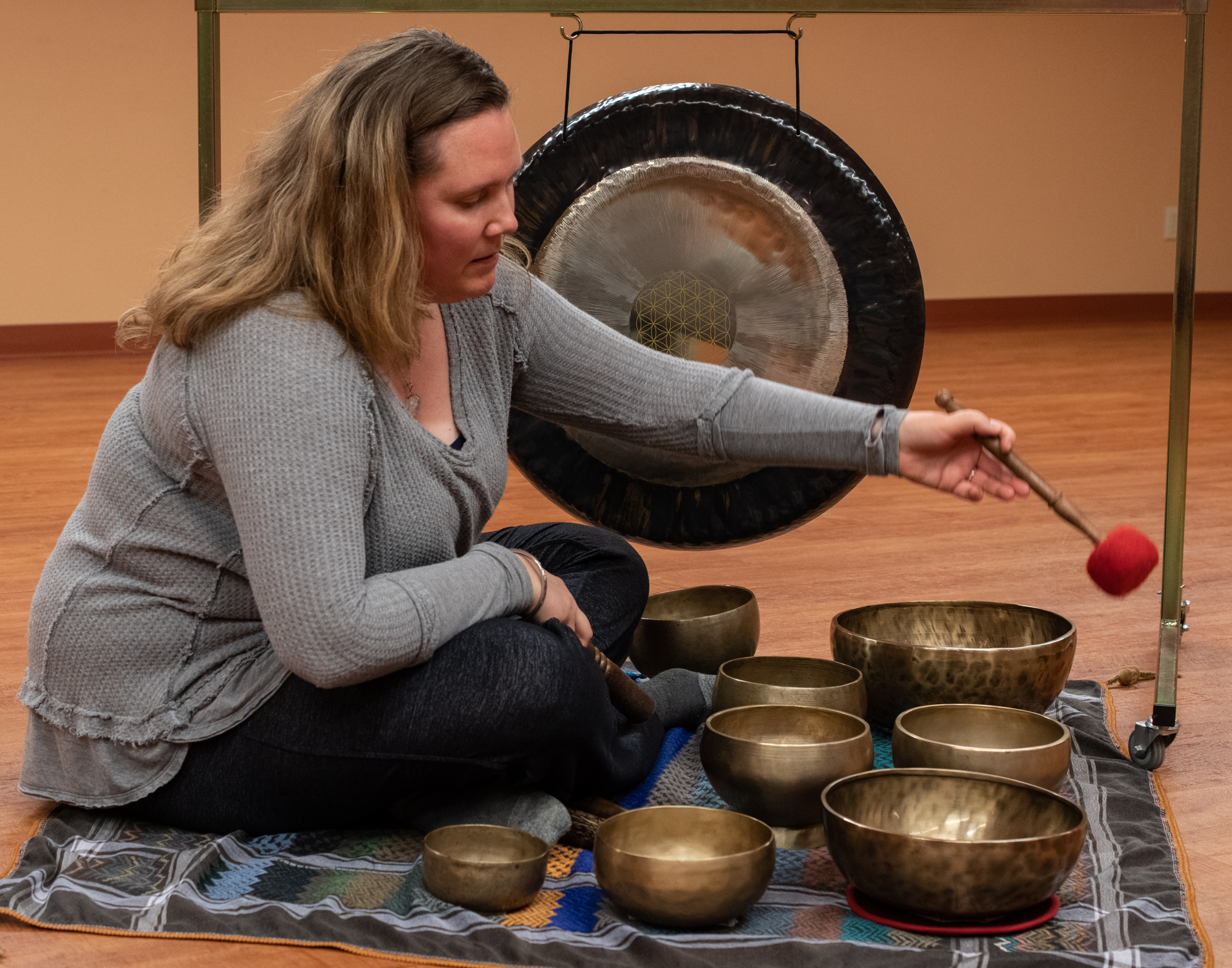
I spend a lot of my life engaging with sound. Recently, I have been creating soundscapes with my gongs, singing bowls, tank drums, and other instruments. It is fascinating to observe the changes that happen in myself and my clients over the course of a sound meditation, as we tune into the soundscape.
All of us live in a constantly changing soundscape, regardless of if we are consciously aware of it or not. Electricity, traffic, fans, the far-off hum of airplanes… these sounds are just a normal part of our existence, something that we often don’t notice until it isn’t there. Turning our focus to sound, deeply listening to the sounds that surround us, be they pleasant or displeasing, is a form of meditation that can be easier to access for some folks than traditional silent meditation.
When my anxiety spikes and I can feel my nervous system moving into fight or flight mode, I often turn to sound to bring myself back down to center. At times I go into my music room and play, sometimes I turn on music that feels soothing to me. Other times I focus on the sound of my breath, and then my awareness naturally expands out to the soundscape around me.
A question that I often get is: does sound have healing properties or will playing specific frequencies or notes have a profound effect? The answer is a definite “maybe.” Everyone has their own experience, and a note or frequency that feels transformative for one person may not have any impact on another. What I do know, from my personal experience and observation, is that sound can help our bodies to calm, and our nervous systems to downregulate. The specifics of what sounds produce that result vary from person to person but putting our focus on the sounds that we have sought out can soothe our nervous systems and help us self-regulate.
So, consider adding sound meditation to your personal toolbox! I teach Sound & Meditation classes at Red Willow periodically and use a variety of instruments at each class to create a soundscape that is designed to be restful and peaceful. There are also free sound meditations available on YouTube and through the Insight Timer app. Experiment and start to notice which sounds are soothing to you and your nervous systems, and which are not. The beauty of using sound is that there is such an enormous variety available, and more than likely there will be something that works for you… it’s just a matter of finding it.
Dropping into Freedom
by Tom Camel
I chopped weeds yesterday. As I moved while chopping, I tried to balance the amount of effort in my movements—left and right, up and down, side to side. I tried to loosen all the muscles I had tightened with one movement and shift that effort to the muscles on the other side. I tried to pay attention to my feelings of balance so as not to be totally in one part of my body. Moving my energy back and forth, I was mindful.
I also wanted smoothness and flow as I shifted my attention back and forth from being mainly within in my body and out in the world around me. I took time to come to a stop, to let go of muscle tension that was not needed, to sense my body fatigue, and to use that information on my decision to change what I was doing and how I am doing it. It is helpful to have an awareness of excessive tightness in your muscles and awareness of muscles that are working too much or muscles that don’t need to be working now. Awareness of a sense of direction in parts of my body as well as the whole body helps me stay balanced.
I learned all this in the Mindful Movement class. I learned (and continue to learn) to have a relationship with my mind and body that’s kinder and more respectful. The education and mindful movement practice helps me find more ease and less pain and I use the activities, education and awareness to find my whole self over and over again. With Mindful Movement, there is an unlimited amount of movement I can have, there’s always ebb and flow happening. The class helps me move in ways that move away from tenseness and pain. I have even learned how to better be in stillness. At the end of the class we lie down and come to quiet. Sometimes when Mari says something about the class that we just experienced, she says it in a way that pulls the activities together in a way that sounds like poetry. She asks us to visualize animals and how they move. It’s like the Native American Medicine Wheel. The Eagle is vision and perspective the wolf is courage and fierceness when necessary to protect ourselves. Imagining these animals and being like them helps me.
As a veteran with an artificial leg, I find ways to move that uses my inner awareness to find balance that is in a different place than if I had two legs. I don’t have to wear my artificial leg to benefit from the Mindful Movement class.
The ways of Mindful Movement gradually soften my body and moves it away from holding and tightening and the principals of balance and wholeness reminds me of Native American ways of the Medicine Wheel. I have learned about being kind to my body and how to have more freedom. I have learned I can do much so more with much less effort using these practices.

PTSD and Mindfulness
by Christine Lustik, PhD
Mindfulness has become a do it all drug. Could it really help support those living with PTSD?
Post-Traumatic Stress Disorder (PTSD) is a response to trauma that can cause a person to relive the event and cause the brain to change in certain ways. Most notably, the amygdala gets stuck in high alert and at the same time, the hippocampus, which is trying to make sense of things for us, connects the current event to the previous traumatic event to warn us and keep us on alert. The brain often makes this connection through a sound or some other sensory clue. This causes high anxiety and exhaustion to occur, among many other possible outcomes.
Now, let’s look at mindfulness. First let’s remember, the goal of mindfulness practice is to bring us back to the present moment. This is most often practiced through mindfulness meditation. This is helpful when done carefully as it can help those with PTSD return from the memory arising of the past event before getting stuck in that memory. In addition, regular mindfulness practice is shown to increase activity in the pre-frontal cortex and decrease reactivity in the amygdala, both of these counteract the effects of the PTSD. This all sounds positive and when applied can help those with PTSD interrupt the brain when it’s remembering the traumatic event as if the event is happening in real time. The more we interrupt and redirect the brain, the more it’s able to create a different neural pathway for those situations.
In 2015 and 2021, systemic reviews of the research to date on PTSD and mindfulness were completed. These reviews determined that there are a lot of promising results, but there is more work to be done. It was determined that we need to study if there are specific types of trauma that respond more positively to mindfulness and also which forms of mindfulness are most effective for PTSD.
So yes, mindfulness practice can support those with PTSD. That said, for mindfulness practice to be effective, it takes regular and dedicated practice to begin building new neural pathways. In addition, researchers have yet to understand fully why some people develop PTSD after a traumatic event, while others don’t, and what triggers traumatic events. Therefore, it is suggested individuals with PTSD work with programs and guides that are trauma-informed to be as safe as possible.

The Journey of Fulfilling Potential
One of the cornerstones of Red Willow Learning Center is belief in the resilience of the human spirit. At the center of this belief is the understanding that we can all get better at this thing we refer to as “bounce-back”. Building this capacity requires that we come to understand and utilize our inner resources. In short, it requires self-awareness.
This journey is a very personal one. It is, of course, an inside job. We believe that within each of us lies the desire to find our place in the world and to live a life of meaning. This very human journey is usually not a straight path. There are twists and turns and plenty of false starts. Yet, given a nourishing and supportive environment, we see the strength of the human spirit triumph over and over again.
Dr. Stephen Porges, the psychiatrist and neuroscientist, who developed the Polyvagal Theory, does an excellent job of helping us understand the importance of feeling safe in this process. When we do not, we just don’t do well. Our biology takes us into states of being that can look like rigid thinking, anxiety, being defensive and even shut down. We cannot be at our best under these circumstances.
How we go about developing the ability to feel safe in this world depends on many factors. In our early years, were we able to learn safe emotional regulation with an adult? Do we currently live and work in a safe environment? These things are, of course, crucially important.
Let’s not forget the inside job part of this. As individuals, we also need to understand ourselves well enough to know whether our environment is truly dangerous or toxic or whether it is the lens of past traumas that we are looking and experiencing the present though. Learning to put the past in its place is our work and requires self-awareness.
What if everyone had the opportunity and the necessary support to take this journey to self-awareness? What if each of us had the skill to persevere despite obstacles? What if we all had a sense of self-worth and place? What would it be like to be a community that supported and even celebrated the journey? What if we all were living to our potential? Now this sounds like a community I would like to be a part of!
Kathy Mangan

Changing Your Path with Mindfulness
“Human freedom involves our capacity to pause, to choose the one response toward which we wish to throw our weight.” – Rollo May
Yoga and meditation have been offered in the detention and prison settings since the mid-1970’s. Although not considered a mainstream approach to health and well-being, these practices are gaining wider acceptance throughout Europe and North America. Studies continue to show the benefits of both yoga and meditation for the incarcerated population. A study reported in 1987 in the Journal of Criminal Justice reported a 35% drop in recidivism for yoga and meditation practitioners after one year as compared to the general population. A more recent study published by the National Library of Medicine in 2017, reported “reduced criminal behavior and re-arrests and recidivism. In particular, 80% of the control group were rearrested by the three-year post-release point, while only 62% of the REVAMP group were rearrested.” The study concluded that the practice of mindfulness may be a significant help to returning citizens as they leave incarceration.
This is all really intriguing. My question always is, “what does this look like in real life?” Since taking over program administration from its founder, Erin Giefer, Freedom on the Inside (FOTI for short) instructors have made well over 2200 participant contacts so I think we can weigh in on this.
Lower anxiety and stress levels. For a full year prior to the COVID-19 lockdown, we collected pre-class and post-class anxiety questionnaires from adult participants participating in yoga and meditation in the Missoula County Detention Facility. Admittedly, 209 complete data sets do not a robust study make; BUT what we found was a marked reduction in anxiety-related symptoms such as racing heart, feeling dizzy and fear of the worst happening.
Why this matters. First off, correction officers report fewer behavior problems in the jail. That in and of itself is probably enough. In addition, we know that an increased ability to manage stress levels leads to more capacity to choose responses appropriate to the situation at hand. This is nearly impossible to do when we have already shifted into the activation of fight/flight. We just behave better when we are not stressed.
Restorative sleep. When the body is tense and the mind is racing, good restorative sleep can be elusive. Learning to stay in the present with what is and gaining clarity on what you do and do not have control over is a really effective way to start to quiet mind chatter and relax the body. Learning to follow the breath and relax both the mind and body is a useful skill for all of us, not just for those who are criminally justice involved.
Why this matters. It is well documented that sleep deprivation has detrimental effects on both the mind and body. Our mental health is CLOSELY connected with sleep. Add to this that sleep problems are very common for people diagnosed with anxiety, depression and bipolar disorder. We know that the imprisoned population are disproportionately affected by mental health concerns, some of what landed them in jail to begin with.
Substance Use Disorder Recovery support. Mindful practices are useful support strategies for drug and alcohol self-control. They have become widely used in both the outpatient and residential setting.
Why this matters. Mindfulness practices literally change the structure of the brain. This means that the well-worn pathways associated with substance use begin to weaken with time and practice while the prefrontal cortex (planning, working memory and self-control) becomes more robust. We feel less threatened and less activated and more able to think things through.
Mind/body Interventions such as yoga and mindfulness practices are relatively inexpensive to provide. They also teach life-long skills and can be practiced by everyone. More importantly, perhaps, is that these practices help foster compassion for ourselves. That sounds like the community I want to live in!
Kathy Mangan
Celebrating Parkinson’s Month
A consistent yoga practice offers strategies and tools to manage and help reduce the impact of Parkinson’s symptoms. When you’re working with a neurological disorder, you’re not just working with the body…you’re working with the brain/mind/body connection. Yoga has a direct neuroscience connection and excels at this. Besides strengthening the mind-body relationship, it helps:
- Improve balance
- Create strength and stability
- Loosen tight muscles
- Reduce anxiety and depression
- Create fluidity of movement
Practicing yoga can help you walk, turn, move and live with more ease and confidence. It helps with daily activities, such as putting on a jacket, carrying and putting away groceries, reaching for an item, getting up from a chair, staying independent longer.
In my seven years of teaching of teaching Yoga for Parkinson’s, I have witnessed the immediate and cumulative impact of our group practice…better posture, easier movement, resilience, hope and raised spirits.
The camaraderie in our classes is uplifting, healing, and the group energy is powerful. My sincere gratitude to our students living with Parkinson’s Disease who face each day’s challenges with courage, grace, and humor. Thank you for coming to class with your stories and jokes and for your compassion and friendship to all who join us.
Please widely share this Yoga for Parkinson’s Class information. We welcome all with Parkinson’s to become part of our community!
Jolyn Ortega
C-IAYT Yoga Therapist